



At a glance
Whether you're participating in a race or out with family and friends, how your boat handles can be the difference between a fun trip and a frustrating one. And in extreme cases, between getting home safely and a serious accident.
In-depth read
Why handling matters
Handling comes down to how easily a line runs, how quickly a sail responds to a trim adjustment, and how much physical effort is required to control the boat. In sailing lines with a Dyneema® core, consistently superior handling is the direct outcome of the in-house research, end-to-end manufacturing process, and rigorous testing that underpin the fiber's fundamental physical properties.
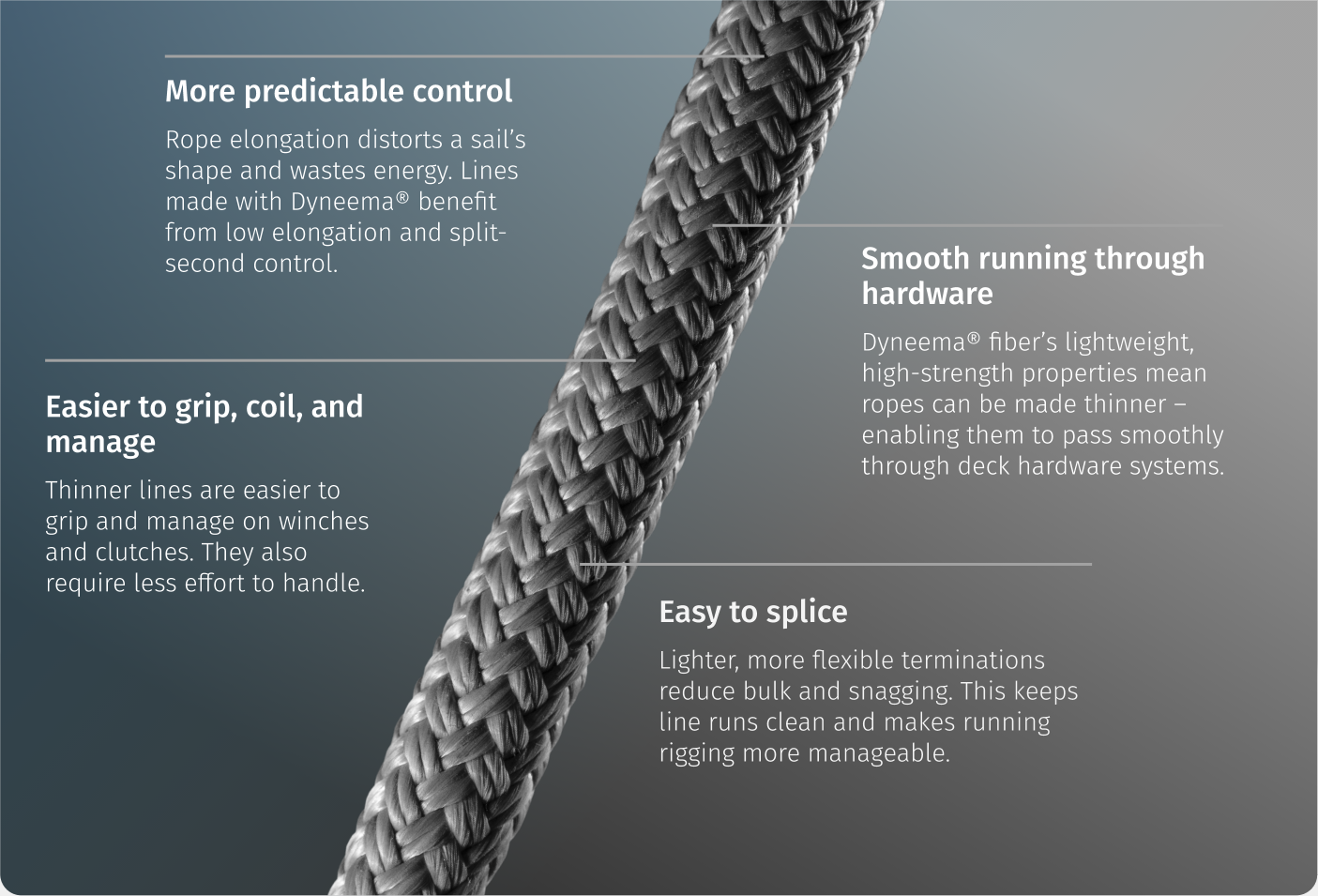
Easier to grip, coil, and manage
Ropes with Dyneema® have an exceptionally high strength-to-weight ratio. This allows them to be made in significantly smaller diameters for the same load capacity, which translates directly into easier handling. Thinner lines are easier to grip, easier to coil, and easier to manage on winches and clutches. Lower rope mass also reduces inertia during trimming and easing, lowering the effort required during tacking, gybing, reefing, or hoisting and dousing spinnakers or gennakers.
Low weight matters even more when a rope is wet. Because Dyneema® doesn't absorb water, it doesn't gain weight when wet and, uniquely among synthetic fibers, it floats. Handling characteristics remain consistent in all conditions. Lines stay light in the hand, do not drag in the water, and are easier to recover and manage on deck. As a sailor, you know the rope will feel the same at the end of a wet leg as it did when you set out. Predictable and familiar.
More predictable control now and long-term
How much a rope stretches under load directly impacts control. When a rope elongates, sail shape changes before you want it to. The sail loses its optimal “wing” profile and energy that could accelerate the boat is lost in the rope.
Sailing lines made with Dyneema® show low elongation, delivering split-second control. Trim inputs translate into immediate sail response, with no spongy or delayed feel at the winch. Fine adjustments remain precise rather than being lost in rope stretch. The handling benefit is tactile and immediate. Similarly, sails made with Dyneema® fiber show the same benefits, with low stretch ensuring you get the maximum speed your setup is capable of.
Low elastic stretch also supports consistent handling for longer. Lines that stretch less under working loads maintain their tuned length and feel, so sail trim remains predictable rather than gradually drifting out of adjustment. The result is reliable control without the constant need to compensate for rope stretch.
Smooth running through hardware
Dyneema®'s lightweight high strength means ropes can be thinner, creating opportunities to design lighter and more efficient deck hardware systems. Dyneema® lines also run smoothly through blocks and sheaves, reducing friction losses and effort during trimming. When lines move more freely, especially under load, repeated maneuvers become less physically demanding for the crew.
Easy to splice
Ease of splicing further improves handling by simplifying the rigging system itself. Lightweight, flexible terminations reduce bulk, stiffness, and snagging risk, contributing to cleaner line runs and more manageable running rigging overall.
Handling is always the result of multiple properties working together. By choosing lines with Dyneema® at their core, sailors are choosing an ecosystem that combines the benefits of light weight, low stretch, smooth running, and real-world ergonomic behavior with years of research, development, testing, and consistent manufacturing quality.