

At a glance
For sailors, performance is the number one priority. But ingredient material choice also has a substantial impact on the environmental sustainability of ropes, sails, and other equipment. By choosing Dyneema® fiber, sailors can address both performance and sustainability without compromise.
Here's how:
The lowest carbon footprint
Dyneema® delivers the lowest carbon footprint per unit strength of any high-performance fiber.
Dyneema® fiber from bio-circular feedstock
To reduce reliance on fossil-based resources, Dyneema® fiber can be manufactured using renewable raw materials, specifically by-product from the pulp and wood industries.
Mass balance accounting
Incorporates bio-circular and circular feedstocks to the flow of materials throughout a complex value chain, without requiring physically separate production streams.
In-depth read
Maximizing strength, minimizing impact
Dyneema® fiber's exceptional tenacity means less material is required to achieve a given level of strength. As a result, Dyneema® delivers the lowest carbon footprint per unit of strength compared to alternative materials such as polyester, nylon, cotton, hemp, or non-Dyneema® HMPE.
Dyneema® is also manufactured using 100% renewable electricity, further reducing the carbon footprint associated with fiber production.
Dyneema® fiber from alternative feedstocks
For applications where sustainability targets are a key consideration without compromising performance, Dyneema® offers Dyneema® fiber made from alternative feedstock.
Dyneema® fiber is always produced from ethylene, using the same advanced manufacturing processes, and delivering the same consistent mechanical performance. The only difference is the origin of the feedstock used to produce the polymer, allowing reduced reliance on fossil resources while maintaining the performance expected from Dyneema® fiber.

Dyneema® fiber from
bio-circular feedstock

Dyneema® fiber from
circular feedstock
Feedstock
origin
By-product from the wood and pulp industries
Recycled mixed plastics
Dyneema® fiber from bio-circular feedstock
By-product from the wood and pulp industries
Dyneema® fiber from circular feedstock
Recycled mixed plastics
Mass balance accounting
Mass balance accounting is a widely used approach for tracing the flow of materials throughout a complex value chain, without requiring physically separate production streams.
It provides a set of rules for allocating the terms 'bio-circular' and 'circular' to different products. Using the mass balance accounting approach, we can allocate the alternative share to the equivalent proportion of product output: products that are then certified as bio-circular or circular according to the ISCC.
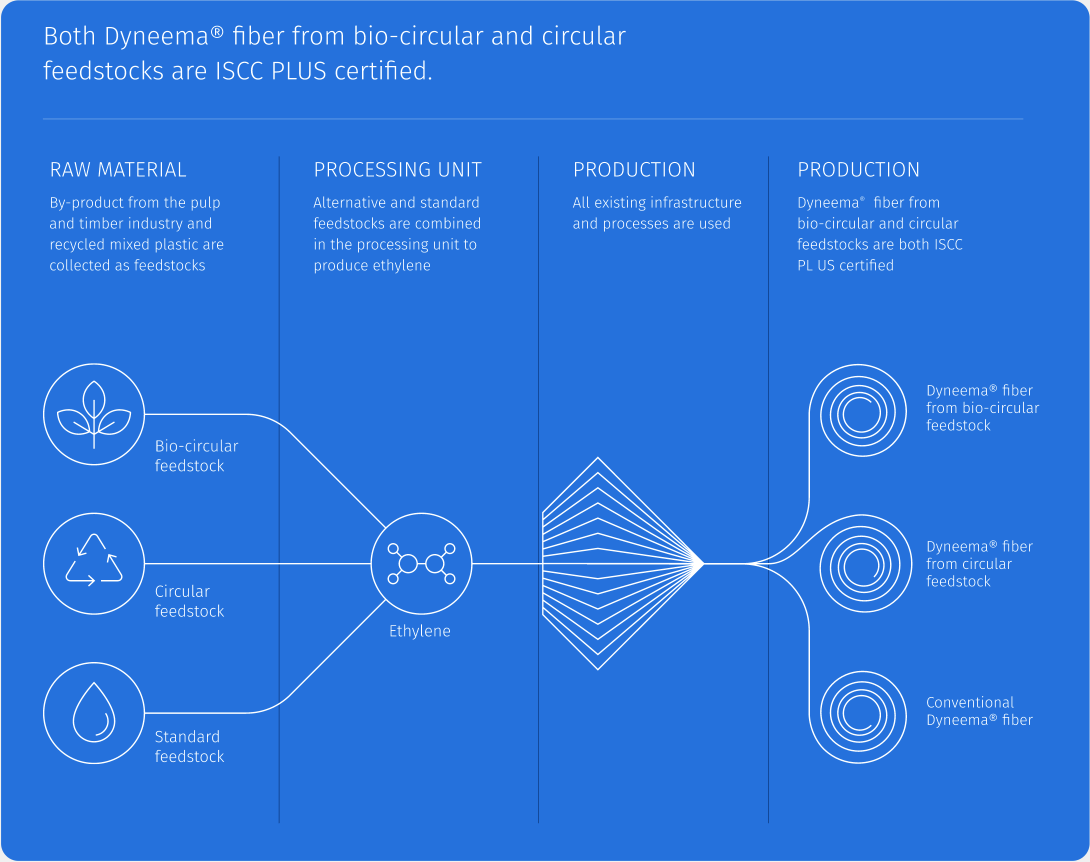
This is how mass balance accounting is applied in the Dyneema® production process:
By-product from the pulp and timber industry and recycled mixed plastic are collected as feedstocks.
These alternative feedstocks are combined with standard feedstocks in the same processing unit to produce ethylene.
All existing infrastructure and processes are followed. Exactly.
The share of Dyneema® made from pulp and timber by-product is labeled as “Dyneema® fiber from bio-circular feedstock.”
The share of Dyneema® made from recycled mixed plastic is labeled as “Dyneema® fiber from circular feedstock.”
The share of Dyneema® made from standard feedstock is labeled as “Dyneema® fiber.”