


At a glance
Dyneema® is the strongest synthetic fiber by weight, with its performance coming from a unique process of molecular engineering.
Here's what that means.
Backward integration
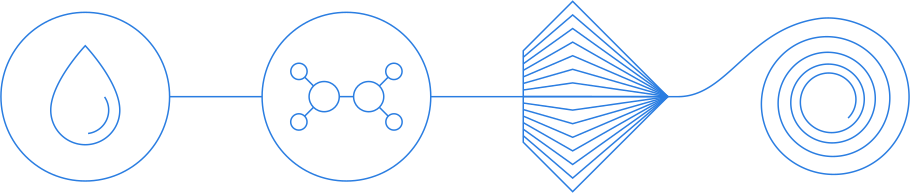
Most HMPE is made from bought-in polyethylene. Only Dyneema® makes its own UHMWPE powder. This allows us to control the entire process from raw material to finished fiber.
Crystallinity
Our gel-spinning process aligns the UHMWPE molecules into tight, ordered chains, which is is the secret to Dyneema®’s lightweight strength and more stable performance under load.
Why molecular engineering matters
Molecular-level engineering enables innovation, allowing us to continually improve the strength and service life of Dyneema® fiber.
In-depth read
HMPE Vs. UHMWPE: what's the difference?
HMPE (High Modulus Polyethylene) is the generic fiber category used in rope engineering to describe high-performance polyethylene fibers characterized by high strength-to-weight ratio and low elongation. UHMWPE refers specifically to the polymer that is used to make HMPE.
In practice, HMPE fibers are produced from UHMWPE polymer using processes such as gel spinning and drawing to achieve high molecular alignment and crystallinity. All HMPE fibers are based on UHMWPE, but the final mechanical properties depend on polymer quality, processing, and molecular orientation.
How backward integration makes Dyneema® different
HMPE fibers are often produced from raw polyethylene purchased on the open market. This can make it harder to control material consistency throughout the production chain, with potential implications for performance consistency.
Dyneema® is different. First, we follow a backward-integrated manufacturing approach. This means we only ever use our own raw materials to make our UHMWPE powder. So, we know exactly where it comes from. This also allows us to perform molecular engineering at the polymer stage.
Next, the UHMWPE powder is dissolved, heated, and forced through a spinneret plate with hundreds of tiny holes in a proprietary gel-spinning process. After extrusion, the fibers undergo a ‘draw’ cycle that further aligns the molecules into long, straight, and compact strands. This molecular alignment gives the fiber its exceptional strength and low stretch. Together, our core R&D, engineering, manufacturing, and testing expertise have enabled us to increase the strength of Dyneema® to the point where it now shows the highest strength to weight ratio of any synthetic fiber on the market.
How crystallinity makes Dyneema® different
Crystallinity is the measure of how much of a polymer's molecular structure is arranged neatly versus how much is not. Nylon and polyester come in at around 30-50%, and aramids and liquid crystal polymer (LCP) at approximately 50-80%, depending on the grade.
The gel-spinning process used in the production of Dyneema® results in very high molecular orientation and high molecular weight (meaning the molecules are neatly arranged and highly packed in a line rather than scattered around randomly). This gives Dyneema® fiber a crystallinity of approximately 85%.

During the gel-spinning manufacturing process, in which Dyneema® fiber is extruded through fine spinneret holes, the polymer chains begin to align in the direction of flow. Then, during the drawing process – which involves stretching the polymer under controlled heat – the chains are pulled tight and become highly aligned and packed together.
This process transforms the disordered, tangled chains into a more ordered crystalline structure, meaning more of the polymer's molecules line up side-by-side in regular patterns.
Figures (a) to (c) show how crystallinity impacts the internal structure of a fiber.
Figures (a) to (c) show how crystallinity impacts the internal structure of a fiber.
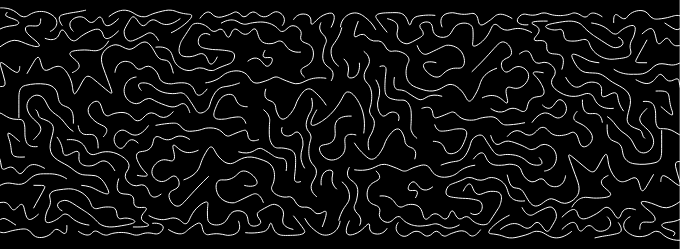
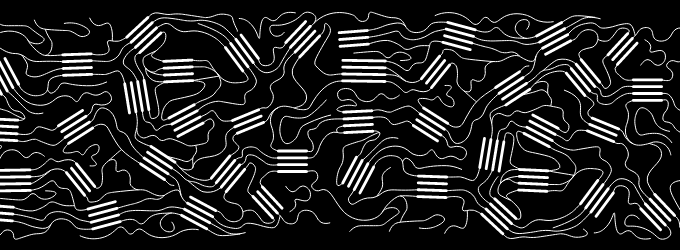
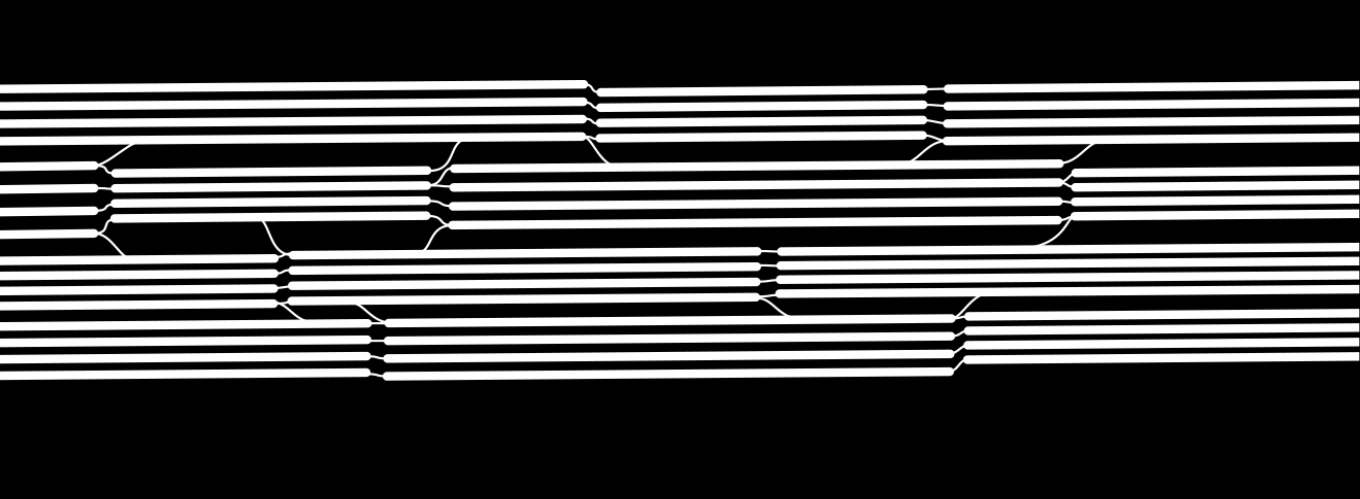
Figure (a) illustrates disordered, tangled chains. Figures (b) and (c) illustrate more ordered crystalline structures, in which more of the polymer's molecules line up side-by-side in regular patterns.
For Dyneema® fiber, this means:
Higher crystallinity =
more molecular alignment and denser packing.
Higher tensile strength =
the load is distributed evenly along the aligned chains.
Lower elongation =
the structure resists deformation under stress.
How chemical anchors and longer molecular chains make Dyneema® different
As mentioned, Dyneema® is unique because it is fully backward integrated: we make our own feedstock and control the full polymer and fiber manufacturing process.
That means we're not limited by "off-the-shelf" feedstock. We engineer the polymer structure itself – finetuning the formation of molecules and designing performance directly into the fiber at the molecular level.
This is what enables innovations such as:
Chemical anchors
• Key for Dyneema® SK78 fiber and even more so for Dyneema® DM20 fiber
• These prevent lines from going slack, giving you more control over your sails and a more reliable, high-quality end product. Thanks to this innovation, lifetime is enhanced by a factor of three vs generic HMPE.
Longer molecular chains
• Key for Dyneema® SK99 fiber
• We create longer molecular chains of HMPE, resulting in a significantly stronger fiber. This is especially crucial for the high-end market, where the highest precision is demanded.
• Ropes responds to change with the highest level of speed and efficiency.