


At a glance
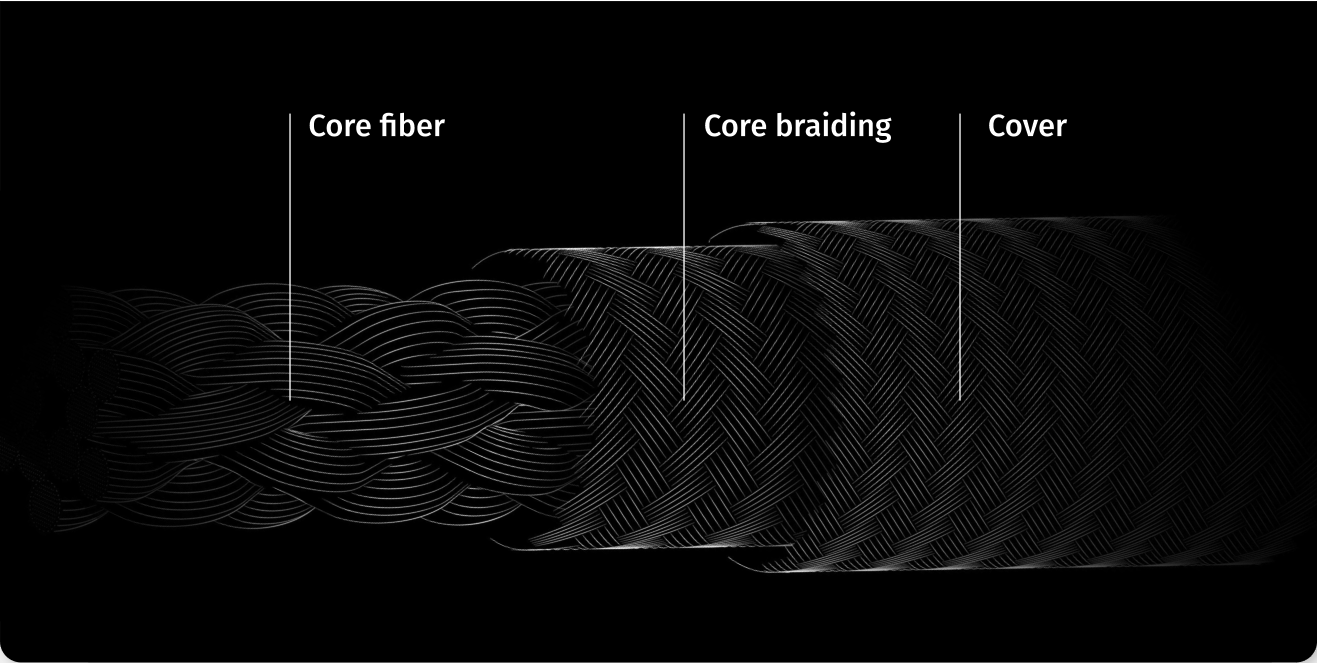
Every component of a sailing rope plays a specific role. Here’s how the core fiber, core braiding, and cover work together – and why each one matters to the performance of the finished line:
Core fiber
Function
Provides tensile strength
Design variables
• Fiber type • Heat setting
Impact on performance
• Strength • Dimensional stability
Core braiding
Function
Distributes load, defines flexibility and torque balance
Design variables
• Strand count • Braid angle • Tension
Impact on performance
• Flexibility • Splicability
Cover
Function
Protects the core and provides grip
Design variables
• Material choice • Weave tightness • Coatings
Impact on performance
• Abrasion resistance • Surface feel/grip • Durability
| Rope component | Function | Design variables | Impact on performance |
|---|---|---|---|
| Core fiber | Provides tensile strength | • Fiber type • Heat setting | • Strength • Dimensional stability |
| Core braiding | Distributes load, defines flexibility and torque balance | • Strand count • Braid angle • Tension | • Flexibility • Splicability |
| Cover | Protects the core and provides grip | • Material choice • Weave tightness • Coatings | • Abrasion resistance • Surface feel/grip • Durability |
In-depth read
The core
The core carries the rope's primary load and defines its tensile strength, stretch characteristics, and stability. It is the true engine of a high-performance rope.
Core types:
12-strand hollow braid core:
Common in ropes made with Dyneema®, this supports the highest strength-to-weight ratio, minimal elongation, and easy splicing.
Braided core:
Multiple smaller braids within the main rope, enhancing load sharing and shock absorption.
Parallel core:
Straight, bundled filaments or plaits used for ultra-low-stretch applications like halyards or static lines.
The cover
Covers are the braided outer layers that protect the core from abrasion, UV exposure, and heat. They also determine the rope's grip, flexibility, and appearance. The natural smoothness of Dyneema® can make it slippery to handle, so most high-performance designs use a Dyneema® core with a polyester blended cover material.
The combination of Dyneema® core and polyester or other synthetic cover ensures:
• Durability and grip (cover) and load strength (core)
• Excellent handling and low weight
• Tunable feel, ranging from soft, flexible sheets to firm and precise control lines.
Braiding
Braiding is the architectural heart of sailing rope design. It defines how fibers interlock, distribute loads and give the rope its flexibility, smoothness, and resistance to twisting (torque). It is essential to work with top quality manufacturers, because no matter how good the core fiber is, you won't benefit if the rope is poorly manufactured.
Key braiding concepts to ask your chandler about:
The number and arrangement of strands
(e.g., 8-, 12-, 16-, or 32-strand rope) dictate the balance between strength, flexibility, and surface texture.
Tighter braids
(higher strand count) are smoother, more compact, and less elastic – ideal for precision handling and reduced friction.
Looser braids
(lower strand count): are more pliable and energy-absorbing – ideal for dynamic or shock-load applications.
Torque neutrality:
balanced braid patterns prevent twisting or hockling under tension, maintaining rope stability when loaded or winched.
Manufacturing quality:
braiding machines interlace the Dyneema® filaments in controlled tension. Even small variations in tension during braiding affect both strength uniformity and rope “hand” (the way it feels and behaves in the hand or hardware).
The extremely low friction coefficient of Dyneema® benefits from tight, balanced braiding (higher strand count). This ensures the fibers don't slip internally and maintains consistent performance, even under cyclical load. The braiding method also affects splicability, stretch behavior, and how easily the rope feeds through blocks or winches.
Heat setting and pre-stretching
Sailing ropes are tensioned and heated (thermal tensioning or heat setting) to stabilize their structure by removing constructional elongation caused by fiber bedding-in, braid tightening, and strand rearrangement. Under load and heat, the fibers and strands settle into their final positions, becoming locked in as the rope cools.
This process:
• Enhances performance consistency.
• Reduces initial constructional stretch.
• Improves dimensional stability under load.
• Gives the rope a denser, crisper feel.